Introduction
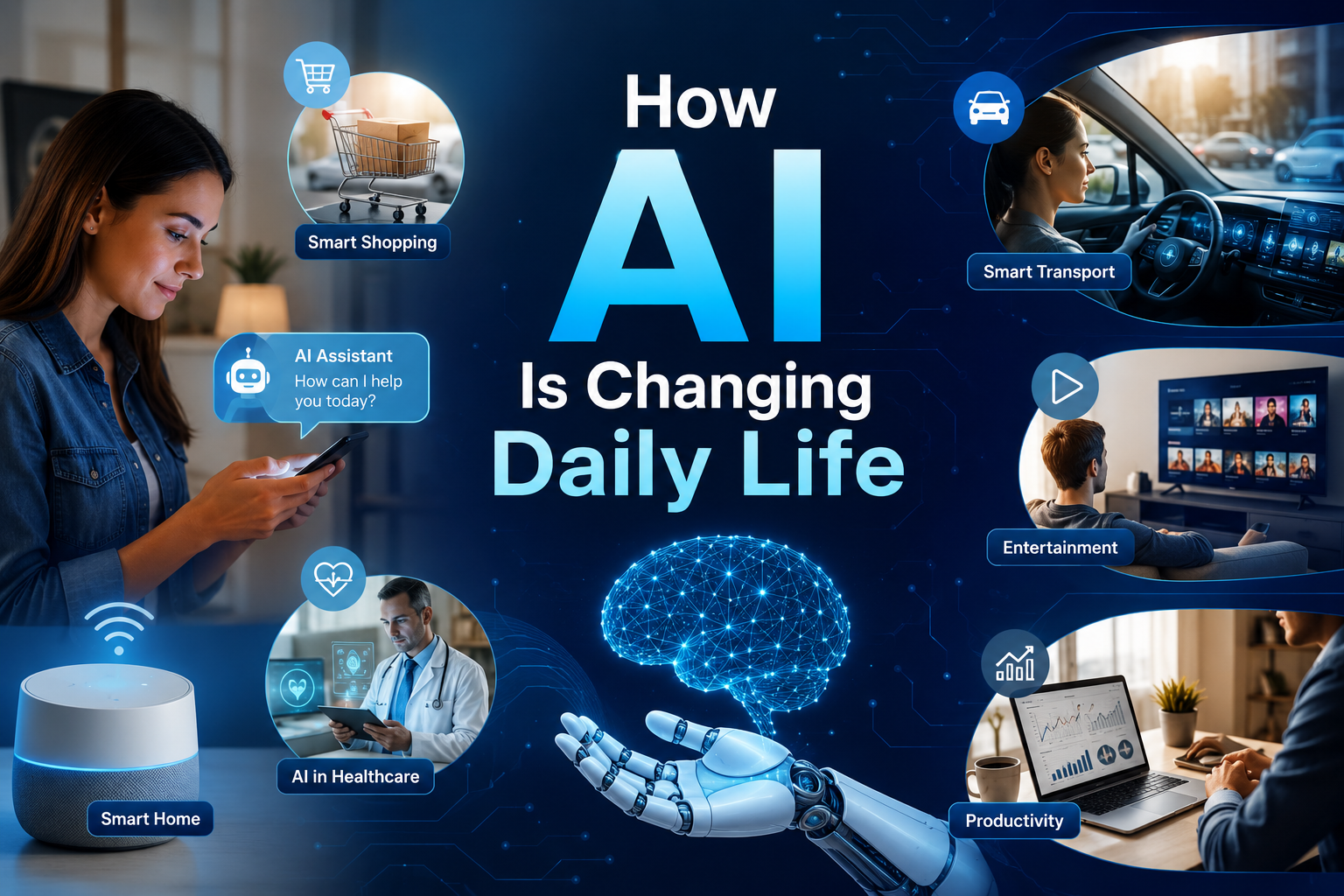
Artificial Intelligence has existed for many years; however, AI is now more than just an exciting concept seen in movies. Its presence in your day-to-day life means that it is now integrated into everything you do on a daily basis including; how you work, shop, learn, and decompress. Many people use AI tools each day without even being aware of doing so. This blog post will examine the real-world and familiar examples of how AI continues to improve our daily lives.
What Is Artificial Intelligence in Simple Words
Machines or software that possess the capability to reason through complex problems and learn from experience (i.e., what they have seen or experienced) are referred to as artificial intelligence. Artificial intelligence technologies are designed to identify and evaluate data and make their own independent decisions, not simply repeat instructions they receive from other people.
Artificial intelligence can provide assistance with various activities such as answering questions, solving problems, and predicting what will likely happen next based on previous experiences.
Voice activated devices, automatic recommendation systems, facial recognition software, smart home appliances, and smart commercial appliances are just some examples of how artificial intelligence is being utilised today.
AI in Smartphones and Apps
The smartphone is an example of AI in everyday life, as many features utilize AI to provide a great user experience.
Many devices include virtual assistants (such as Google Assistant and Siri) that understand spoken commands. These apps allow users to set alarms or reminders, send text messages, search online for information and control smart home devices.
Most camera apps use AI to enhance quality by adjusting exposure based on ambient lighting conditions, removing blurriness from photos taken at high-speed, as well as automatically recognizing faces.
Predictive text and auto-correct features found in modern phones utilize AI to suggest appropriate word choices when typing. Users benefit from this feature because it enhances their typing speed and accuracy.
Battery management in today’s smartphones utilizes AI technology by learning how users engage with their devices and then optimizing battery life based on your usage patterns.
AI at Home and Smart Living
Home technology has become smarter with the advent of artificial intelligence (AI). The rise of “smart” devices—such as speakers, lights, and thermostats—has led to improvements in the convenience and comfort of living in these homes due to their ability to respond to voice commands and regularly scheduled user activities.
Smart home technology can automate many functions (like controlling the temperature, lights, and security) by learning the homeowner’s routine through AI. For example: an AI controlled thermostat will automatically reduce its power consumption when nobody is home.
AI is used by robot vacuums to create a map of the home and to effectively clean the home on that map. Smart security cameras can detect motion, identify faces, and send alerts in real-time when motion is detected.
These technological advancements enable homeowners to live a more convenient, secure, and energy-efficient lifestyle.
AI in Online Shopping and Entertainment
AI is utilized in the background of online shopping. By making product suggestions based on a shopper’s previous activity, including the pages they visited and what they previously purchased, AI allows users to find items quickly, as well as find new items that they would enjoy.
Shopbots on e-commerce sites allow customers to ask questions, track packages, and get assistance without speaking to a human being, saving both the customers and the businesses time.
On video streaming platforms, such as Netflix and YouTube, AI helps the users find content to watch based on their likes and dislikes. As the users continue to spend time using the streaming services, theai learns and evolves to provide even better suggestions over time.
AI in Education and Learning
The way that we learn is changing because of AI (artificial intelligence). Online learning sites use artificial intelligence to help you choose courses and lessons that match your skills and interests.
Some applications will automatically adjust the pace of your learning according to how well you understand a topic. For instance, there are several AI Tutors that can be used to help students practice Math, Language, and Coding at their own time and pace.
Teachers also benefit from artificial intelligence by using tools to help them evaluate students’ work, monitor students’ progress, and find out which students need more help with subject matter. As a result, teachers spend less time grading assignments and finding and correcting mistakes, and spend more time actually teaching.
Because of artificial intelligence’s flexibility and global reach, education can now reach students anywhere in the world.
AI in Health and Fitness
AI is significantly impacting the health and fitness industry. For example, fitness applications use AI to monitor an individual’s activity level, counting steps and providing workout suggestions based on individual fitness goals.
Smartwatches also utilize AI, as they monitor heart rates, sleep patterns and stress levels. This information can then be evaluated using AI algorithms to derive health-related information and notify users of any changes in their health.
In the health care arena, AI can assist physicians with early disease recognition through analyzing medical imaging and patient information data. Further, Physician support systems powered by AI will allow for earlier and more accurate diagnosis with better treatment plans.
These tools are designed to assist individuals with the everyday management of their health.
AI at Work and Productivity
The rise of AI has had a profound effect on the way work gets done, particularly in the workplace and in online jobs. Email filters, scheduling assistants, and document editors are just some examples of how artificial intelligence can help save time through automation.
AI-enabled tools can parse through emails, provide suggested responses, manage to-do lists, and help write better by finding errors in spelling/grammar, recommending changes, and speeding up the drafting process.
When it comes to business, AI is being used to analyze data and forecast future trends, providing recommendations for improved management of inventory, and delivering improved levels of customer service.
AI has made remote work much simpler by allowing workers to conduct meetings, translate language, collaborate, etc., all through the power of AI-based solutions.
AI will not eliminate all jobs; however, it will continue to transform the nature of work — primarily by taking care of repetitive tasks.
AI in Transportation and Travel
AI enhances the experiences of transportation and travel. For example, navigation applications employ AI for predicting traffic patterns, finding the quicker routes and providing ETAs (estimated times of arrival).
Furthermore, ride sharing apps, such as Uber and Lyft utilize an AI platform to match drivers to riders and determine fair fares. Additionally, airlines use AI systems to monitor airline schedules and improve safety.
AI systems are being developed to create self-driving vehicles by using AI technologies to recognize road surfaces, road signs and road obstacles. Although not yet at a stage where fully autonomous vehicles are developed, AI is able to assist drivers with parking, brake and lane control.
Benefits of AI in Daily Life
By automating repetitive processes, AI provides time savings for numerous areas of business. It enhances accuracy, convenience and efficiency throughout various industries.
AI provides abilities to better analyze data for making sound decisions and provides better access for individuals with disabilities by utilizing smart technology and voice control.
In all cases, AI allows for more creativity and meaning in one’s life.
Challenges and Concerns of AI
Although AI has its advantages, it also poses problems; one of the biggest ones is that AI collects tons of personal information and can invade people’s privacy.
The effect of automation on jobs has some people worried about how many jobs will be lost as a result of this type of technology. Additionally, there are also concerns about how individuals may misuse AI in the future, and how AI lacks a person’s ability to use sound judgment.
To create as much benefit from AI for all people as possible, people need to be educated on how to use it responsibly and create regulations that govern it.
Conclusion
Artificial Intelligence (AI) affects many parts of everyday life without anyone realising it i.e. smartphones/homes/education/health/work making our lives easier/more efficient. AI is here to stay and grow. It is important to understand how AI works so you can use AI confidently/wisely on a daily basis.