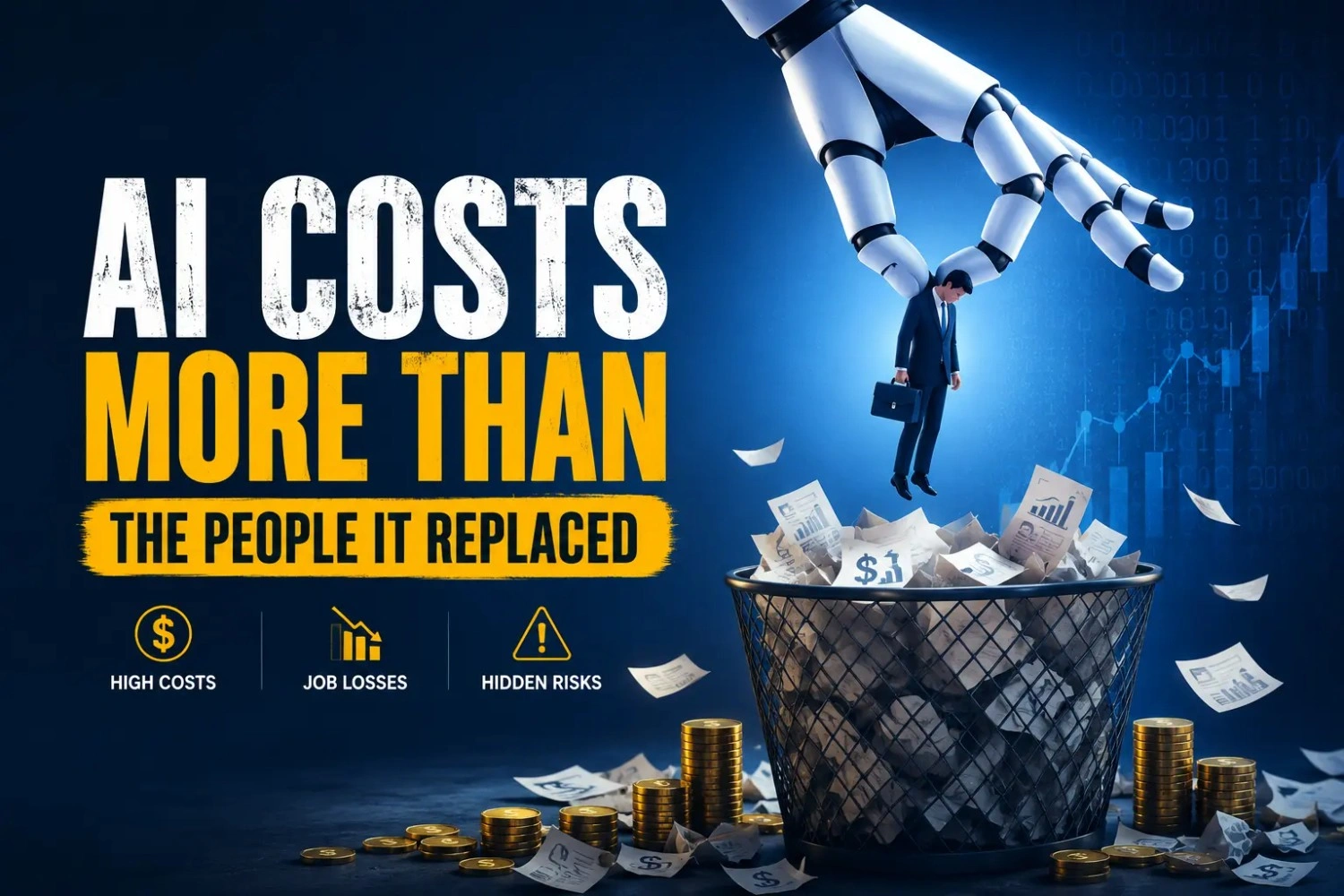
AI Costs More Than The People It Replaced
So here’s something nobody wants to admit out loud.
Companies spent the last two years bragging about cutting staff and “letting AI handle it.” Clean story. Fire a few people, plug in a tool, pocket the difference. On paper it looked genius.
But walk into a lot of those same offices in 2026 and you’ll hear a very different conversation. Quieter. A little embarrassed. Because the cheap AI they bragged about? It’s eating more money than the workers they showed the door. I want to break down why, because once you see it, you can’t unsee it.
The Salary Was Never the Real Cost
When a boss replaces a $60,000 employee with software, they only see one number disappearing. Nice and simple. What they forget is the weird thing that person did every single day. They ran themselves. You paid them, and then they just… worked. They made calls. They caught their own mistakes. They asked for help when they were stuck. Nobody had to sit next to them holding their hand.
AI doesn’t work like that. Not even close. That tool you bought is just the doorway. The real cost is standing right behind it, and no salesperson is going to point at it during the demo.
The Bills Nobody Warns You About
This is where the whole “we’re saving money” story starts falling apart, and it usually starts with compute. Every task the AI does eats processing power, and power is not free. Those cloud and usage bills look tiny at first. Then your team actually starts using the thing, and the number climbs. And climbs. One month you glance at the invoice and go, wait, what?
Then there’s the people you hire to run the AI, and this is the part that kills me. To replace one $60K worker, companies end up hiring prompt specialists, data folks, an “AI lead” who costs a fortune. You didn’t delete a salary. You swapped it for two bigger ones and called it progress. On top of that, somebody has to clean up the mess, because AI is confident even when it’s dead wrong. It’ll write broken code, make up facts that don’t exist, and completely miss what you asked for, all while sounding sure of itself. That somebody is usually a well-paid human who now spends half their day double-checking a robot.
And don’t forget the pile of subscriptions. One tool for writing, another for images, another for coding, another for support. Each one seems cheap on its own. Add them up and suddenly your monthly software bill is staring back at you like an old payroll sheet.

A Story That Says It All
Picture a small marketing agency. They had three writers, about $150K a year between them. Management got excited, decided AI could do the work, and cut it down to one writer plus a stack of tools. Huge win, right? That’s what they told everyone.
Then real life showed up. The AI content came out flat, so the one writer they kept was suddenly buried in edits, working late just to make it usable. They stacked on premium plans for writing and images and SEO. They brought in a consultant to “fix the prompts.” Clients started complaining that everything sounded the same, so now there were rewrites on top of rewrites. Fast forward twelve months and their costs were barely lower. Some months, honestly, higher. And the work was worse than before. The savings only ever existed on the first slide of the pitch.
Why This Keeps Happening
The trap is that AI feels free in the beginning. The first results come out fast and shiny, and people assume it stays that easy forever. It doesn’t. Here’s the truth. AI is amazing at knocking out 80% of a job in about ten seconds. Feels like magic. But that last 20%, the part that actually matters, still needs a real human brain. And that little stretch at the end is exactly where all the money hides. Judgment, context, taste, knowing when something’s off. None of that comes bundled in the subscription. Companies budget for the tool. They completely forget to budget for everything that stops the tool from embarrassing them in front of a customer.
AI Isn’t the Bad Guy Here
Let me be fair, because I actually love this tech. The problem was never using AI. The problem is treating it like a full replacement for a person instead of what it really is: a helper. A very fast, slightly clueless assistant. Look at the companies actually winning right now. They didn’t fire everyone. They kept their sharp people and handed the boring, repetitive junk to AI. Now their team gets more done in less time, and the humans still make the calls that matter. That mix, human judgment plus AI speed, is where the savings actually live. Not in the layoffs. Never was.
What This Means For You
If you run a business, or you’re itching to go all-in on AI, just pump the brakes for a second before cutting your team. Ask yourself the honest questions. What does this actually cost after the free trial dies and usage scales up? Who checks the AI’s work, and what do you pay that person? How many separate tools are you really subscribed to right now? And is the quality good enough that customers won’t notice, or worse, walk away? Run that math with real numbers, not the dream version. Nine times out of ten you’ll find that a small, sharp team using AI smartly beats a “fully automated” setup that’s quietly bleeding you dry.
The Bottom Line
AI got sold to us as the ultimate money-saver. For a ton of companies, it turned into the exact opposite. A shiny, hungry system that needs constant feeding and a babysitter. Here’s the lesson of 2026, plain and simple. Tech doesn’t erase your costs. It just moves them somewhere you weren’t looking. The businesses that get this will use AI to make their people stronger. The ones that don’t will keep scratching their heads, wondering why their “cheap” little robot ended up costing more than the human ever did. Turns out the most expensive move of all is believing a machine can fully replace a person. It usually can’t. And the bill? It always shows up eventually.