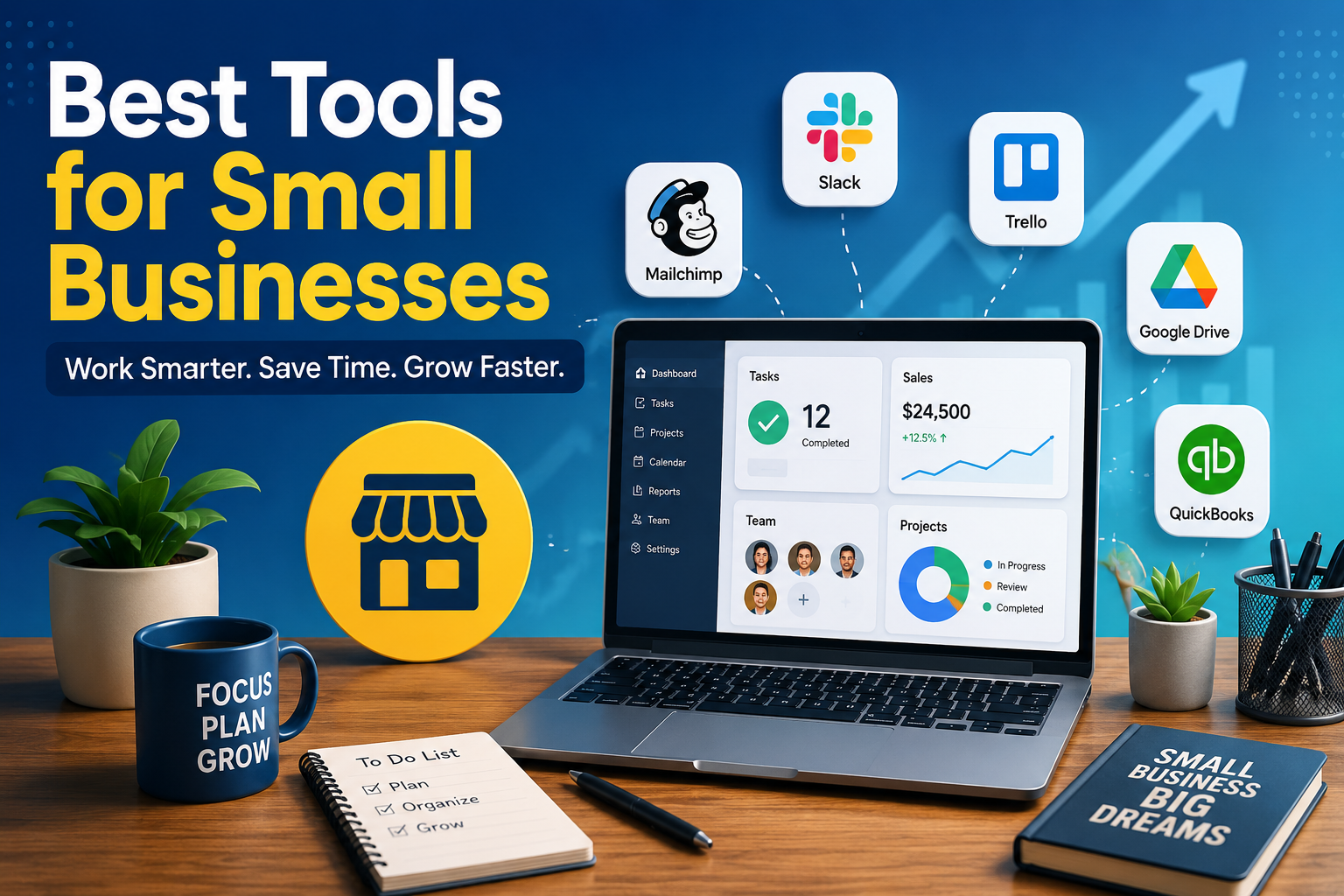
Best Tools for Small Businesses to Grow Faster and Work Smarter
Running a small business is a continuous balancing act. You have to manage customers, handle finances, promote your brand, track performance, and still find time to improve your product or service. Most small business owners start with limited resources, so every decision matters. This is why using the right business tools is so important. These tools are not just software, they are systems that support your daily work and long term growth.
Small business tools help reduce manual effort, improve accuracy, and save time. They also allow you to look professional and organized, even if you are running the business alone. In this detailed guide, each category of tools is explained clearly so you understand why it matters and how it helps small businesses in real life.
Why Small Businesses Must Use Digital Tools
Small businesses that rely only on manual work often struggle with consistency and growth. Digital tools bring structure to your business. They help you keep records, track progress, and avoid confusion.
Tools also help businesses scale. When your customer base grows, tools allow you to handle more work without hiring too many people. They improve speed, reduce errors, and help you focus on decision making instead of repetitive tasks. Businesses that use tools usually perform better because they understand their data and workflows.
Communication Tools for Small Businesses
The most important form of communication for every successful company is through the use of effective communications tools. Poor communication results in numerous mistakes, missed deadlines, and unhappy customers. Helpful communication tools allow businesses to remain organized and on track with all forms of communications.
Business Email tools, such as Gmail and Outlook, provide the framework necessary for professional-level communications. Having a personalized email address creates trust and builds credibility within a company. Gmail’s ability to integrate seamlessly with Google Drive gives users an easy way to send and receive files. Microsoft Outlook is geared towards businesses that have to use Microsoft Word and Excel on a regular basis for their day-to-day business operations.
Team communication tools help to decrease confusion and misinterpretation among teams. Slack is designed for discussions to take place in an organized manner, via “channels”, so that users can locate specific conversations much quicker, rather than having to sift through an overloaded inbox. Microsoft Teams provides an all-in-one, integrated platform combining chat/text, meeting, and file sharing, which is extremely useful for remote/hybrid workforces.
Online face-to-face video meeting tools allow businesses to develop a personal connection with clients while meeting remotely. Zoom allows for meetings, webinars, and recording of video. Google Meet is browser-based and provides a simple-to-use platform for both businesses and clients. Utilizing these online video meeting tools eliminates travel time, making communication much easier.
Marketing Tools for Small Business Growth
Marketing has two purposes: attraction and retention of customers. Failure to utilise appropriate tools will result in marketing becoming sporadic and untrackable.
Social media management tools allow marketers to create an advanced plan for content sharing. Hootsuite enables the control of multiple platforms through a single dashboard to effectively manage time and consistently post content. Buffer is designed for beginners and tracks engagement so marketers can determine which content resonates with audiences best.
Email marketing tools can be used by marketers to build and maintain relationships with customers. Mailchimp enables marketers to send newsletters, promotions and automated emails to customers through an easy-to-use platform. Comprehensive reporting also provides insight as to how many customers opened and clicked on emails. MailerLite also targets small businesses looking to use automated emails simply and send high-quality graphics through their platforms.
Design tools help to present a strong brand image. Canva enables non-designers to create high-quality graphics using templates. Their platform can be used to create graphics for social media posts, advertisements, banners, and presentations in a user-friendly manner. Adobe Express enables marketers to create design pieces quickly and in professional layouts.
Website Tools for Online Presence
There are multiple options when creating your own website. A website is your first opportunity to create a positive impression of your business. A website also serves as a source of information about your business, demonstrates trustworthiness, and is a source of potential customer leads.
Website builders such as Wix enable users to quickly build their own websites using drag-and-drop functionality. Users do not need to have any programming skills to do this. Squarespace is another popular website builder used by creative businesses because it creates very modern, sleek-looking sites.
WordPress is one of the best content management systems available today. Not only does it give users complete control over their site’s design and functionality, but it also allows users to install various plugins that can add additional SEO capabilities, security features, and forms for gathering contact information. For more established businesses looking to expand into the future, WordPress is a good choice for the long term.

Ecommerce Tools for Selling Products Online
Selling online requires reliable systems for managing products, payments, and customers.
Shopify provides everything needed to run an online store. It handles inventory, orders, payments, and shipping. WooCommerce is a flexible option for WordPress users who want customization.
Payment tools ensure smooth transactions. PayPal is trusted globally and easy for customers. Stripe supports credit cards, subscriptions, and international payments, making it suitable for growing businesses.
Scheduling and Booking Tools for Service Businesses
Managing payments, products, and customers efficiently is critical when selling online.
For that reason, Shopify encompasses features that would serve as the backbone system of your eCommerce company, such as inventory management, order management, payment processing and shipping options. Alternatively, WooCommerce provides flexibility, allowing you to customize your eCommerce experience via WordPress.
Traditional payment processors allow you to accept payments seamlessly from customers. PayPal’s brand recognition makes it popular with consumers; they trust it implicitly. Stripe enables processing of credit card purchases, subscription services and the processing of international transactions. It makes sense for companies that have growth potential.
Finance and Accounting Tools for Small Businesses
Proper financial management is essential to business survival; without good tools, it can be hard to keep track of income and expenses.
QuickBooks manages your accounting, invoices, and financial reports and makes tax preparation easier, while FreshBooks is useful for freelancers or agencies that need to invoice clients frequently.
Expense-tracking solutions minimise confusion when it comes to tracking your spending. Expensify lets you scan and categorise receipts and expenses, while Wave offers free invoice and accounting software, making it perfect for new businesses.
Project Management and Task Tracking Tools
Project Management Software helps keep a company organized and on track with deadlines while increasing teamwork and accountability.
Trello is a visual representation of tasks through boards (for overview) and cards (for details) that is easy to use for small teams.
Asana is structured by creating a list of tasks, deadline dates, and used for monitoring progress on each of those tasks.
ClickUp allows businesses to combine task management, document management, and goal setting within one platform. Notion provides businesses with the ability to develop their custom workflow for project management, data storage, and note-taking.
Customer Support Tools for Better Service
Customer service solutions are designed to help organizations effectively manage their customer requests. Providing quick support will result in improved customer service levels for their customers.
Zendesk aggregates messages sent by telephone, email, chat, or through social networks. Freshdesk offers a ticketing system for customers, as well as assistance via automated responses.
Live chat applications enable users to communicate in real-time with other users. LiveChat includes additional options available to users, while Tawk.to is available free of charge for small business owners.
Automation Tools to Improve Efficiency
By establishing connections between applications, automated solutions decrease time spent performing manual work, as well as increasing accuracy through decreased human error.
Zapier offers integrated workflows between applications (for instance, when users submit forms, Zaps created in Zapier will automatically update the customer relationship management (CRM) software you use). For more intricate automation processes, the Make software creates visual workflows.
The automated capabilities provided by these tools enable smaller businesses to successfully manage their business operations utilizing minimal resources.
File Storage and Collaboration Tools
Business data remains safe, yet accessible with file storage tools. While Google Drive enables real-time collaboration, Dropbox permits users to sync files and control versions.
Employing file storage solutions helps employees collaborate more effectively without any misunderstanding.
Productivity and Time Management Tools
Task and idea management is accomplished using productivity tools. Examples include Evernote, which offers storage options for both notes and checklists, as well as Microsoft OneNote, which has an interface with Microsoft Office products.
Toggl and similar time tracking solutions allow people to see where their time goes, improving their planning and efficiency.
Analytics and Reporting Tools
Performance can be measured by using analytics tools. Google Analytics allows you to see how people are visiting and using your website. Hotjar can demonstrate how users engage with your website.
Social media analytical tools, such as Sprout Social, give insight into audience engagement. Later allows you to create and plan for visual content.
Decisions based on data will yield better results.
Final Thoughts
The right tools can provide small businesses with a more effective use of their time and better organization, as well as enabling growth. Identifying the essential tools for your purpose and implementing them first will set you up to add additional tools when you are ready.