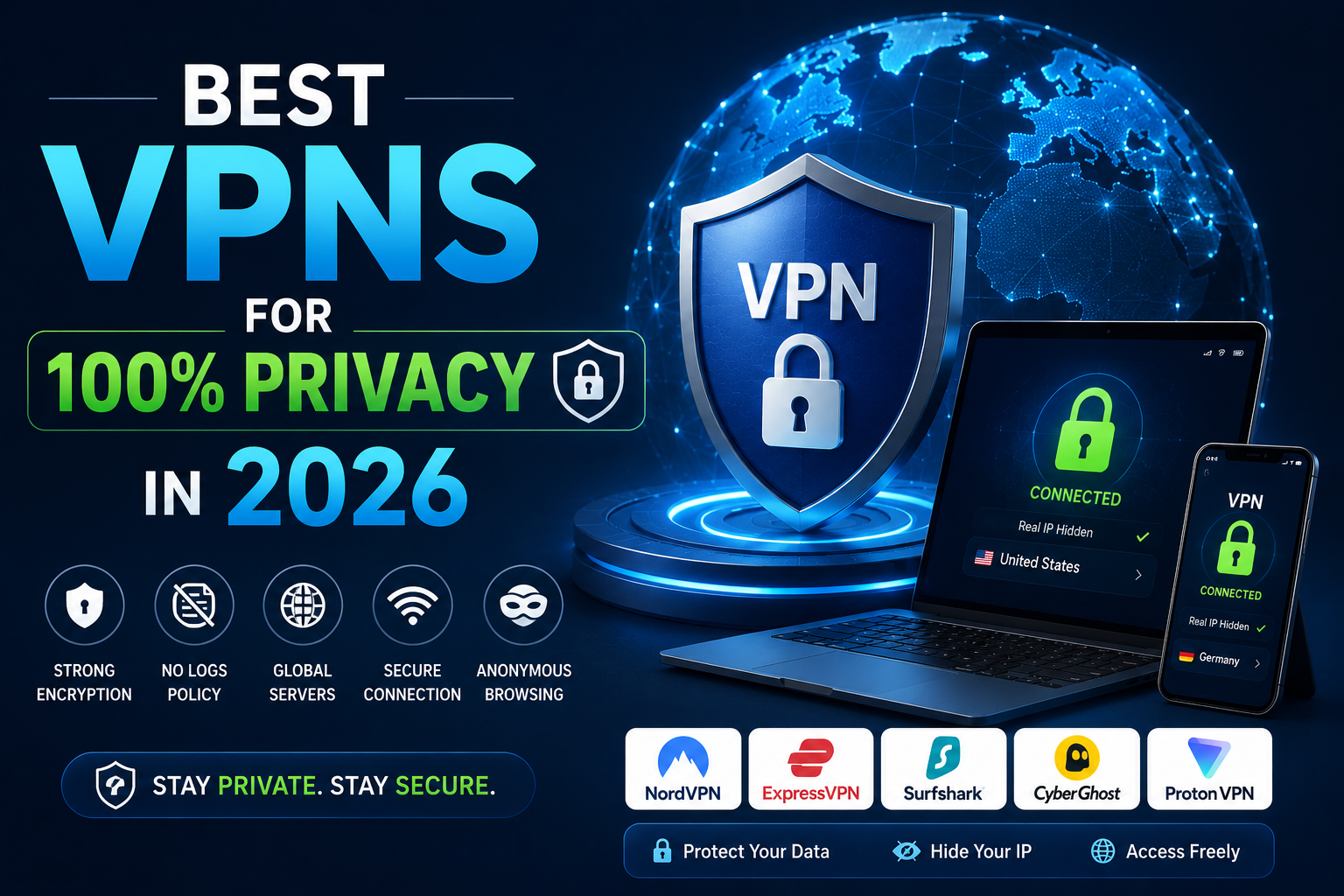
The Best VPN Services for Privacy 2026 will be something every one needs if you want to protect your information while using the internet today. With an increase in online dangers such as Data breaches, Internet tracking and unsecured Public Wi-Fi; All this creates increased levels of risk when sending or receiving any type of digital data over the internet. The use of a good VPN is an effective method of concealing your identity on the internet whilst at the same time providing additional security by encrypting all of your Internet activity.
We will take a close look at what constitutes a Quality VPN that focuses on User Privacy and Security. In addition to this, we will provide descriptions of the features of each of the VPN services to allow you to select which is the right VPN for you to use from among the following selected VPN services in the Guide: 2026 best VPNs available today that provide User privacy, services; as well as providing Quality service, user trust and user transparency.
What Does 100% Privacy Really Mean
We know that honesty is key. There is truly no online service available that will provide 100% confidentiality when it comes to your information. If a company logs data or has weak legal standards, your personal information may be violated. Proper privacy measures include the use of strong encryption methods, the absence of log files for monitoring user activity, and servers located outside of countries that require data to be collected.
A VPN focused on providing privacy should perform three primary functions:
1) No log files should be maintained regarding user activity.
2) The use of modern encryption that cannot easily be broken.
3) The VPN provider must be open and honest about how their service operates and must be able to substantiate their claims through independent auditing.
Why VPNs Are More Important in 2026
Technology is better, but so too is technology to surveil us like never before. Smart devices are also continuously collecting data about the people who use them. The free Wi Fi networks that still exist are unsecure.
Mobile data services are also not totally private; Internet Service Providers (ISPs) can still monitor the traffic you are generating. Countries over the world are now requiring retention of your data by your ISP through the use of various forms of legislation.
Using a Virtual Private Network (VPN) provides you with a significant amount of protection. A VPN encrypts your traffic and hides your location. However, while it does not replace smart habits, it does provide a much higher degree of protection than without.
NordVPN One of the Best VPNs for Privacy in 2026
NordVPN remains one of 2026’s best-performing VPNs due to its commitment to user privacy, having operations based in Panama (which has no data retention obligations) and demonstrates how national laws will dictate a company’s ability to provide your information to others when operating from within a country.
Additionally, all of the servers operated by NordVPN only use RAM-based storage; therefore, when any particular server shuts down or restarts, it will lose all.
NordVPN has a wide, modern selection of encryption techniques as well. They will also provide you with a stable, fast connection speed when connecting between various countries; NordVPN also provides you with additional protection through double VPN routing and threat protection, while not complicating your organization.
NordVPN is a very good option for its users who need privacy through speed and dependability, and do not want to create any unnecessary technical issues.
Express VPN Trusted VPN for Privacy in 2026
ExpressVPN is known for providing a high level of trust and a strong history of reliability. They have developed a model where their server farms are operated entirely in memory, which greatly decreases the possibility for data leakage and long-term data retention.
The result has been multiple audits and numerous real-world tests that returned zero user data. This gives customers cemented confidence in their privacy statements.
ExpressVPN strives for ease of use – apps work cleanly and are intuitive and simple to operate, even for people new to the Internet. The encryptions used work seamlessly in the background with virtually no impact on the performance of regular web browsing.
Although ExpressVPN may be more expensive than other options, many people select ExpressVPN due to their long-standing reputation of safeguarding user privacy without any exceptions.
Proton VPN Privacy Focused VPN in 2026
The Proton VPN was created by the same people that brought you Proton Mail (a very private and secure email service). They are based out of Switzerland (where there are very strong laws regarding privacy).
Proton VPN does not log any user activity whatsoever and regularly provides transparency reports on this. Additionally, all of their applications are open source so developers and programmers can review their source code for potential flaws or security holes.
Multi-hop routing is one of the greatest privacy features offered by Proton VPN. By routing traffic through multiple secure locations prior to it being transmitted to the internet, tracking user behaviour becomes extremely challenging.
Proton VPN does provide a free version that maintains user privacy. While speeds are limited to a certain extent on the free version, Proton VPN has stated that they do not sell user data or show advertisements which is a rarity.
Mullvad Anonymous VPN for Privacy in 2026
For maximum anonymity use Mullvad – no login or email required… just receive a randomly assigned account number.
Mullvad removes a major privacy risk in that personal information is not tied to your usage of the VPN service. Furthermore, you can pay anonymously!
Mullvad has no log policies that have been independently verified. They use state-of-the-art encryption methods as well as modern protocols to secure your data.
Mullvad doesn’t have a flashy look; rather their focus is on privacy through minimising all extra features.
Surfshark Affordable VPN for Privacy in 2026
Surfshark has developed rapidly, while still placing a high priority on protecting customers’ privacy through its no-logs policy and independent audits.
One of the benefits of Surfshark is the ability to protect an unlimited number of devices at the same time from private internet access (PIA). This is useful for families or someone with several laptops and cell phones.
Another benefit is the ability of Surfshark to block trackers and websites with malicious content at the network level, providing you with an extra measure of protection when using the internet.
Lastly, Surfshark is an affordable option, yet it offers excellent encryption, providing customers with high-quality service.
How to Choose a VPN for Privacy
When considering which VPN to use, keep in mind that advertising and popularity probably will not determine which one is right for you; instead, focus on facts.
Determine whether the entity operates under the supervision of independent security audit agencies.
Note where the company is registered for legal purposes.
Read the privacy policy thoroughly, especially the sections dealing with records being kept.
Be cautious of free VPNs that do not provide a clear-cut explanation as to their method of funding.
Although speed is important, protecting your privacy is even more so. A slightly slower connection is worth the price to ensure your data confidentiality is protected.
Common VPN Myths
There’s a common misconception about a VPN being used for illegal purposes only. That assumption is incorrect. A VPN provides many protections to everyday users by safeguarding them against tracking, identity theft and data leaks.
Some people believe a VPN provides total anonymity. Not true! It’s still important to observe good practices and habits such as using strong passwords and keeping devices up to date.
Another misconception is that all VPNs work the same way. They don’t! Logging policy differences and the security of servers can greatly affect how well your VPN will protect you.
Can a VPN Replace Antivirus Software
A VPN provides protection for your network connection, but not for your devices. Therefore, a VPN will not remove any malware or block all threats from the internet. For the most degree of safety, you should always use a VPN and have secured/updated software as well as other security measures.
Wrap up
Achieving privacy in 2026 is an effort. One of the best tools to protect your online world is a VPN. However, making a wise choice in selecting a VPN is essential for effective protection.
The top five VPN providers are NordVPN, ExpressVPN, ProtonVPN, Mullvad, and Surfshark. In addition to focusing on user control, trustworthiness, and transparency, they will limit the amount of data collected about you and provide true security rather than just a marketing gimmick.