Introduction to Data Engineering
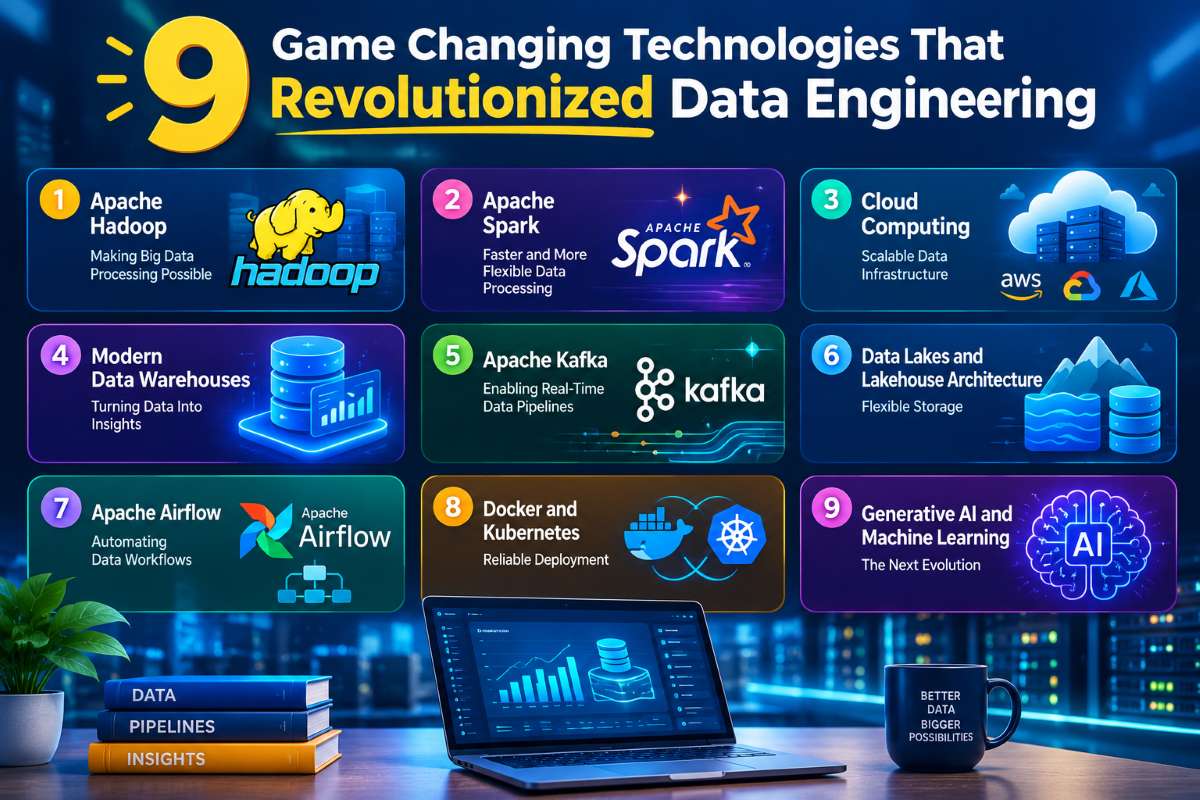
Data engineering technologies have transformed how businesses collect, store, process, and analyze information. From Apache Hadoop and Apache Spark to cloud computing and artificial intelligence, these innovations help organizations manage large datasets and build efficient data pipelines. Understanding these technologies is essential for businesses looking to improve data-driven decision-making and for beginners planning to build a career in data engineering.
Understanding these technologies is essential for businesses, developers, and aspiring data engineers. Whether you’re building an analytics platform or preparing for a data engineering career, learning how these innovations work can help you understand the tools powering today’s digital world.
1. Apache Hadoop: Making Big Data Processing Possible
Apache Hadoop revolutionized data engineering by making it possible to store and process enormous datasets across multiple computers. Before distributed processing became widely accessible, organizations often faced significant limitations when handling large volumes of information using traditional systems.
Hadoop introduced technologies such as the Hadoop Distributed File System (HDFS) and MapReduce. HDFS distributes data across machines, while MapReduce enables parallel processing. Although newer cloud platforms and processing engines have replaced Hadoop in some environments, its distributed computing principles remain influential.
2. Apache Spark: Faster and More Flexible Data Processing
Apache Spark transformed big data processing by providing a powerful engine for large-scale data transformations, analytics, and machine learning. Its ability to cache data in memory can significantly improve performance for workloads that repeatedly access the same datasets.
Data engineers use Spark to clean information, combine datasets, process logs, and prepare analytical tables. Its support for Python through PySpark also makes distributed computing more accessible to developers familiar with Python.
3. Cloud Computing: Scalable Data Infrastructure
Cloud computing changed how organizations build and maintain their data infrastructure. Instead of purchasing physical servers and managing every component themselves, companies can use cloud platforms such as Amazon Web Services, Microsoft Azure, and Google Cloud.
Businesses can scale resources according to demand without investing heavily in hardware upfront. Cloud computing also allows distributed teams to access shared infrastructure and deploy data pipelines more efficiently. However, organizations still need to manage security, permissions, performance, and costs carefully.
4. Modern Data Warehouses: Turning Data Into Insights
Modern data warehouses have made large-scale analytics more accessible. Platforms such as Snowflake, Google BigQuery, and Amazon Redshift help organizations store structured information and run analytical queries across large datasets.
Data engineers extract information from different sources, clean it, and organize it into reliable data models. Business analysts can then use these datasets to understand customer behavior, monitor sales, and measure business performance. Cloud-based warehouses also reduce the burden of managing physical infrastructure, allowing teams to focus more on data quality and analytics.
5. Apache Kafka: Enabling Real-Time Data Pipelines
Apache Kafka changed how applications exchange and process data by introducing a widely adopted approach to event streaming. Instead of waiting for scheduled batch jobs, organizations can publish events and make them available to other systems continuously.
For example, an online store can use Kafka to capture customer orders, payment updates, and inventory changes. Other applications can consume these events to update dashboards, monitor transactions, or detect suspicious activity. Kafka helps build scalable, event-driven systems and supports applications that need fresh information with low latency.
6. Data Lakes and Lakehouse Architecture: Flexible Storage
Data lakes allow organizations to store large volumes of information in its original format, including structured tables, JSON files, application logs, and documents. This flexibility makes them useful for analytics, experimentation, and machine learning.
Lakehouse architecture addresses some of these issues by combining flexible data lake storage with features commonly associated with data warehouses. Technologies such as Apache Iceberg and Delta Lake support reliable table management and analytical workloads. This approach allows teams to use shared datasets across different applications without maintaining completely separate storage systems for every purpose.
7. Apache Airflow: Automating Data Workflows
Apache Airflow simplified the management of complex data pipelines. A typical pipeline may involve collecting information, validating records, transforming datasets, loading results into a warehouse, and refreshing reports. Airflow allows engineers to define workflows as directed acyclic graphs, commonly known as DAGs. It supports scheduling, dependency management, retries, and execution monitoring. By coordinating multiple tasks in one workflow, Airflow helps teams build more maintainable data systems. It is especially useful when pipelines involve numerous interconnected processes that must run reliably.
8. Docker and Kubernetes: Reliable Deployment
Docker and Kubernetes have improved how data engineering applications are packaged, deployed, and managed. Docker packages software and its dependencies into containers, helping applications run consistently across development, testing, and production environments.
It can help coordinate deployments, allocate resources, scale workloads, and recover from certain failures. These capabilities are valuable for organizations operating complex data platforms and distributed services. Although not every data pipeline requires Kubernetes, containerization can make software deployment more consistent and reproducible.
9. Generative AI and Machine Learning: The Next Evolution
Data engineers now help prepare training datasets, maintain feature pipelines, process documents, and support retrieval augmented generation systems. Vector databases and embedding pipelines can help AI applications retrieve relevant information from large collections of text. Generative AI tools can also assist with SQL generation, code documentation, and troubleshooting. However, engineers must continue to verify outputs and maintain strong standards for data quality, privacy, and security.
Conclusion
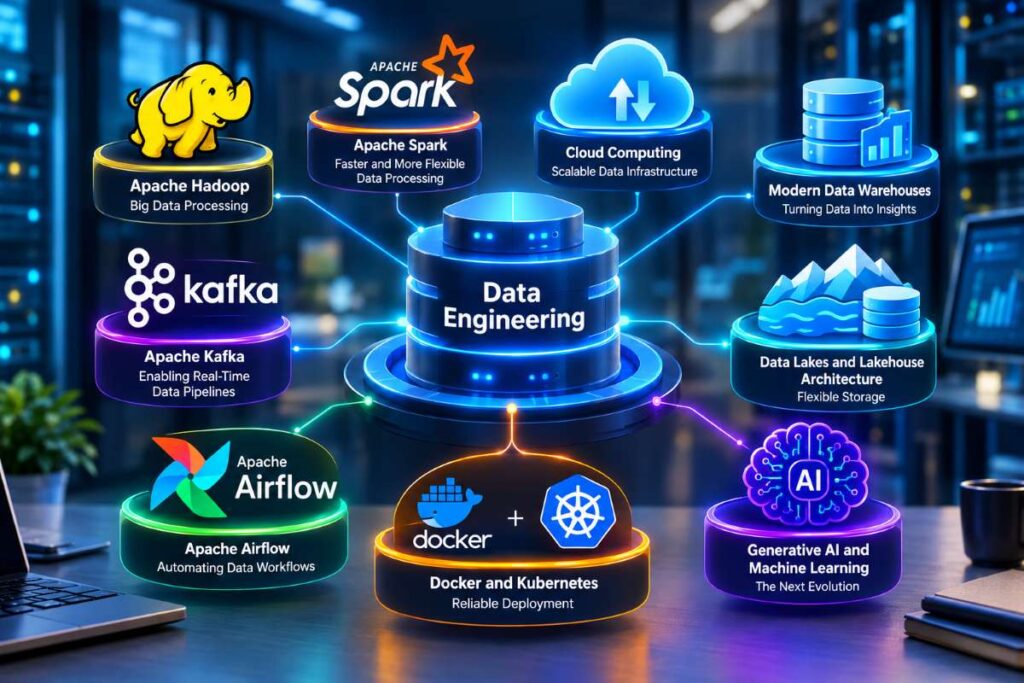
The nine technologies that changed data engineering forever have reshaped how businesses manage information. Hadoop established important distributed computing foundations, Spark improved large-scale processing, and cloud computing made infrastructure more flexible. Kafka enabled event streaming, while modern data warehouses, lakehouses, and orchestration tools made analytics pipelines more reliable and accessible.
Meanwhile, Docker, Kubernetes, machine learning, and generative AI continue to expand the possibilities for building modern data platforms. No single technology is ideal for every situation, so successful data engineers must understand the problem before selecting the right tools. By learning SQL, Python, cloud fundamentals, and data pipeline design, beginners can build a strong foundation for working with these technologies.
Frequently Asked Questions (FAQs)
Data engineers need strong SQL and Python skills, knowledge of databases, and an understanding of ETL pipelines. Familiarity with cloud platforms, data modeling, and distributed processing tools can also improve career opportunities.
Modern technologies have made data processing faster, storage more scalable, and workflows easier to automate. They also help businesses process real-time information and build reliable data pipelines for analytics and AI applications.
Cloud computing provides flexible storage, processing power, and managed data services. It enables organizations to scale infrastructure according to demand while reducing the need to maintain physical servers.
Real time data processing helps businesses respond quickly to changing conditions. Companies can monitor transactions, detect suspicious activities, track customer behavior, and update operational dashboards with fresh information.
Artificial intelligence is more likely to change data engineering tasks than eliminate the profession.